Bluefin on the troll: Jack Leyden of North Kingstown, RI and Doug
Poscich of Stonington, CT with a 60 pound bluefin they caught at Tuna Ridge, 20
miles southeast of Block Island Sunday.
Scientists raise red flag about dogfish
Things were looking up for dogfish
(small sharks). They received a lot of
positive press last year about their potential value to fishermen (as a species
to be fished), as table fair for consumers and as a boost to fishing
communities in general.
The idea of marketing and promoting
dogfish for the dinner plate was a good one… there are plenty of dogfish and they
are easy to catch. What made it even
better is that both commercial and recreational fishermen do not like the small
shark. Spiny dogfish are relentless
predators. They steal bait and eat forage
fish, clog fishing nets and are caught as by-catch when recreational fishermen are
targeting other species. So to find a
solution that works, catching spiny dogfish and sell selling them as food for
human consumption, was a win, win solution for fishermen and the consumer.
The idea of marketing and promoting
dogfish as table fair is being investigated by the University of New England (UNE)
with a $245,000 National Oceanographic & Atmospheric Administration (NOAA) grant
to explore the “Optimum Utilization of Spiny Dogfish… through industry partnerships
and product development marketing.” said the UNE in a April 1, 2014 article
posted on their website. The project
goals are “to increase domestic quota utilization for spiny dogfish, boost the
consumer market for the fish, increase revenue and jobs for fishermen from
North Carolina to Maine, and help restore an improved ecosystem balance.”
Spiny dogfish are not yet in high demand as a food item in the United
States but the idea is to build demand. They are popular on the international
market and are often served as "fish and chips" in Europe. Last year when the industry movement to
promote dogfish started, fishermen in RI and along the east coast were very
positive about the dogfish market.
The movement to promote dogfish as
spices for table fare has spread to recreational fishing too. A number of internet inquiries and posts
have explored ways to catch, clean and prepare spiny dogfish for human
consumption.
Last month a collaborative study on
dogfish was published by Roger Williams University and the University of Rhode
Island. The study examined the mercury (Hg)
content in smooth dogfish, spiny dogfish, little skate and winter skate as well
as in their prey (scup, butterfish, longfin squid and cancer crabs). The study area included Rhode Island Sound,
Block Island Sound and Narragansett Bay.
Dr. David Taylor of Roger Williams
University said “As you may be aware,
due to declines in traditional bony fish fisheries, there’s been an increase in
the use of cartilaginous fish e.g. dogfish and to a lesser extent skates) as a
human dietary resource. I have recently published an article on the
mercury contamination in these cartilaginous fish.”
Dr. Taylor’s study found that “From
a human health perspective, 87% of smooth dogfish, 32% of spiny dogfish, and
less than 2% of skates had mercury (Hg) concentrations exceeding the US
Environmental Protection Agency threshold level (0.3 ppm wet weight). These results indicate that frequent
consumption of smooth dogfish and spiny doggish may adversely affect human
health, whereas skates present minimal risk.”
With commercial fishermen and recreational
anglers exploring ways to clean, prepare and eat dogfish it is important to
keep study conclusions in mind. “From a human health perspective, consumption
of smooth dogfish and, to a lesser extent, spiny dogfish pose a human health
risk, and therefore, justifies stringent consumption advisories for these
species. Conversely, the consumption of skates does not present a significant
risk to human health. It is the recommendation of the authors that this
information be effectively communicated to the general public so that citizens
can make informed decisions regarding the safe consumption of fishery
resources.”
The study “Mercury bioaccumulation in cartilaginous fishes from Sothern New England
coastal waters: Contamination from a trophic ecology and human health
perspective” was published May 29, 2014 by Marine Environmental Research 99
(2014) 20-33 and can be found at www.sciencedirect.com
.
Study collaborators included David
L. Taylor and Nicholas J. Kutil of Roger Williams University Department of
Marine Biology and Anna J. Malek and Jeremy S. Collie of the University of
Rhode Island Graduate School of Oceanography.
No single study should set the tone
and direction of a fishery and no doubt further studies on dogfish will be conducted.
However, Dr. Taylor and his colleagues have raised a red flag about dogfish,
one that should be seriously considered by consumers, scientists, fishermen and
government officials.
New England Boating TV in Newport
The New
England Boating television program is in its second year airing on New England
Sports Network (NESN) and they are doing a program on Newport, RI this
season. This Friday, I served as fishing
guide for co-hosts Tom Richardson and Parker Kelly. We landed four fluke in a matter of 40
minutes all keepers with the largest being 21”. Al Elson of Striper Marina
captained on a new Pursuit 30 foot center console that he sells at Striper
Marina, Barrington. Christina, Al’s
daughter, served as first mate. New England Boating TV program features coastal
towns that boaters/fishermen can visit and highlights shops, restaurants,
tourist sites and where to fish when in the area. Visit http://youtu.be/q795Qdlg2w0
for an interview with show host Tom
Richardson about the show’s first season and what you might expect to find on
the website www.newenglandboating.com.
Operation Dry Water aims to
reduce alcohol and drug related accidents on water
Safe boating
patrols will be stepped up on June 27 to June 29 in a joint operation conducted
by the Department of Environmental Management’s Division of Law
Enforcement. The effort is part of Operation Dry Water, a coordinated
national weekend of Boating Under the Influence (BUI) detection and
enforcement. It is aimed at reducing the number of alcohol-related and
drug-related accidents and fatalities, and making recreational boaters aware of
the dangers of alcohol and drug use on the water. During Operation
Dry Water, DEM marine law enforcement officers will be out in full force on
Rhode Island waterways, searching for boat operators whose blood alcohol
content exceeds the state limit of .08 percent.
Impaired boaters can expect to be arrested or face other serious
penalties.
Fooling fish with soft plastics
Al “Gag”
Gagliarducci is well-known around the country (and world) as the owner of Al
Gag Custom Lures, but he is also an expert fisherman that knows how to fool
fish with soft plastic baits.
Gagliarducci will be the featured speaker at the Monday, June 30, 7:00
p.m., Rhode Island Saltwater Anglers Association (RISAA) seminar at the West
Valley Inn, West Warwick. "There's
a lot of things that come into play when fishing with plastics. You need to
take into consideration the tides, water clarity and what type of bottom you're
fishing on. Even the type of algae and plant life growing in the area helps
decide what colors to use." said Gagliarducci. RISAA members are free, $10 donation for
non-members. Visit www.risaa.org for details.
Where’s the bite
Summer flounder (fluke) fishing remains good with anglers landing
some very large fish, some catching their limit and others are working hard to
catch one or two. Roger Simpson of the
Frances Fleet said, “In general there were many limit
catches this past week …There were exceptions… especially on days with the
slower drift conditions when buck tails prevailed.” Larry Norin of Cumberland landed “Flukezilla”
Friday… a 12.06 pound, 31” monster in the Jamestown Bridge area. Lary said, “I was in 35 feet of water using
one of his homemade fluke rigs with squid strips.” Friday, fishing with the New
England Boating TV show and Al Elson of Striper Marina we landed four fluke in
a matter of 40 minutes all keepers with the largest being 21” drifting south
from the Newport Bridge along Rose Island on the outside of the red can in
about 120 feet of water. Fished there
the next day and did not have good luck at all. Mike Cardinal of Cardinal Bait & Tackle,
Westerly, said, “Fluke fishing along the southern coastal shore is good, very
steady.” Angles are catching fluke in the Nebraska Sholes and Watch Hill Beach
area with a lot of black sea bass being caught.
Ken Ferrara of Ray’s Bait & Tackle, Warwick, said, “Fluke fishing in
the east passage on the flats from Conimicut down to Prudence Island is very
good.”
Striped bass fishing still good in the Bay and improving at Block Island
“especially at night ” said Capt. Rick Bellavance of Priority Too charters. Mike Cardinal of Cardinal Bait & Tackle,
Westerly, said, “There are larger bass now mixed in with smaller fish which are
being caught by shore anglers off Watch Hill, Weekapaug and Charlestown
beaches. We weighed in a 45.7 pound Block Island bass this week.” John Littlefield of Archie’s Bait &
Tackle, East Providence said, “Bass in the 14 to 17 pound range are fairly
common being caught on live menhaden or chucks behind Crescent Park, Conimicut
Light and Barrington Beach on the channel pads. The bluefish are there too and
guys are going through 12 to 15 pogies just to catch their limit of two striped
bass.” Noted local fly fisherman Ed
Lombardo said “We fished the Narrow River … tide was
outgoing… fish where easy when we first got to the river… We then moved down
river to the sandbars closer to the mouth and pick up some nice fish that where
bigger. The fish seem to like flies that are streamers made of craft fur or
bucktail, brown over white, olive over white and all white, high tie style. My
hot pink high tie worked very well to.”
Scup fishing
picked up dramatically this week. Mike from Cardinals Bait, Westerly said,
“Shore anglers are experiencing a good scup bite.” John Littlefield of Archie’s bait said, “Scup
in the 12 to 13” range are being caught at Colt State Park, Ohio Ledge, and Conimicut
Light. Some anglers have caught their
limit.” Scup limit is 30 fish/person/day
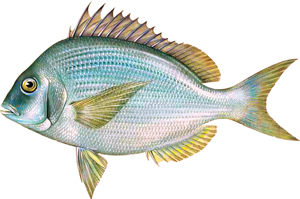
with a minimum size of 10”. However, a
9” minimum size prevails for shore anglers fishing only in special provision
areas including India Point Park, Providence; Conimicut Park, Warwick; Rocky Point,
Warwick; Stone Bridge, Tiverton; East and West Walls (Harbor of Refuge),
Narragansett; Fort Wetherill, Jamestown; and Fort Adams, Newport.
Offshore bite
improved this week with several reports of bluefin being caught. Jack Leyden of North Kingstown fished 20
miles southeast of Block Island in the Tuna Ridge area Sunday. Jack said, “Caught a BFT (60
pounds) … trolling ballyhoo and artificials. Whales, porpoises abundant in flat
calm seas.” Jack was fishing on Stepping Stone, a 45 foot Cabo.
Shore fishing has been fair with a few larger
fish now being landed. Mary Dangelo of
Maridee Bait & Canvas, Narragansett said, “Monday morning the striped bass
bite was on at Narragansett Town beach.
Anglers caught school bass with some keepers mixed in. Black sea bass
fishing from shore has been good too, hope this hold for when the season starts
(June 29).” The scup bite has been good
from shore at Colt State Park in Bristol as well as in the Westerly and Charleston
areas said Mike Cardinal of Cardinal Bait. Dave Pickering posted this on his
blog Tuesday (www.ristripedbass.blogspot.com),
“I fished yesterday evening and found almost
non-stop bluefish action in the Bay from shore.”