Ralph Craft, owner of Crafty One Customs, with one of his custom rods “Striper Sniper” that he built for an Iraq veteran. Mr. Craft said, “Crafty One Customs is the ‘Orange County Choppers’ of custom rod building.” Visit them at http://www.crafty1customers.com/. Tuesday, April 5, 2011
Great to learn more about striped bass
Ralph Craft, owner of Crafty One Customs, with one of his custom rods “Striper Sniper” that he built for an Iraq veteran. Mr. Craft said, “Crafty One Customs is the ‘Orange County Choppers’ of custom rod building.” Visit them at http://www.crafty1customers.com/. Tuesday, March 8, 2011
NOAA supports catch shares as fisheries management tool
Dave Pickering, who has landed more than 50,000 striped bass from shore, will be one of the guest speakers at the East Bay Anglers’ Fishing Expo scheduled for Sunday, January 30, 2011. The event will take place at Barrington High School starting at 11:00 a.m. For information visit www.rifishshow.com.
Early last month the National Oceanic and Atmospheric Administration’s (NOAA) Fisheries Service issued a press release announcing a new NOAA policy that encourages the consideration and use of catch shares as a fishery management tool.
Jane Lubchenco, Ph.D., under secretary of commerce for oceans and atmosphere and NOAA administrator said, “NOAA’s policy encourages fishery management councils and stakeholders to explore the design possibilities of catch shares to tailor programs to best meet local needs.” The announcement was met with praise and criticism from the recreational angling community.
What are catch shares?
I have seen a number of definitions… what catch shares use to mean versus what it commonly means today. This week, I checked NOAA’s definition in their recent press release and Wikipedia’s definition.
According to Wikipedia, “The term ‘Catch Share’ has been used more recently to describe the range of programs similar to ITQs (individual transferable quotas). Catch shares expand the concept of daily catch limits to yearlong limits, allow different fishers to have different limits based on various factors, and also limits the total catch. Under catch share approaches, threatened fisheries became sustainable by keeping the totals low enough and enforcing the limits.”
NOAA relates that catch share programs, which include limited access privilege programs and individual fishing quotas, dedicate a secure share of fish to individual fishermen, cooperatives or fishing communities. Catch shares are used in 14 fisheries managed by six fishery management councils from Alaska to Florida and are being developed in additional fisheries. Both here and in other countries, catch shares are helping eliminate overfishing and achieve annual catch limits, improve fishermen’s safety and profits, and reduce the negative biological and economic effects of the race for fish that develops with some traditional fishery management.
Wikipedia relates that, “… a crucial element of catch share systems is how to distribute/allocate the shares and what rights come with them. The initial allocation can be granted or auctioned. Shares can be held permanently (owned) or for a fixed period such as one year (rented). They can be salable and/or leasable or not, with or without limits. Each variation has advantages and disadvantages, which may vary given the culture of a given fishing community.”
The Center for Coastal Conservation (CCC), a coalition of leading advocates for marine, recreation fishing and boating supports many aspects of the new NOAA catch share policy. CCC members include the American Sportfishing Association, The Billfish Foundation, Coastal Conservation Association, International Game Fish Association and the National Marine Manufacturers Association.
In a CCC press release Mike Nussman, president and CEO of the American Sportfishing Association, said, “It’s clear that NOAA’s leadership was listening at its Recreational Fishing Summit last April when the entire spectrum of the recreational angling community, form guides to tackle manufactures to charter boat operators, voiced its apprehension regarding this policy… A number of significant improvements called for by participants at the summit and in subsequent dialogue with the agency are reflected in this document.”
The recreational fishing community feared catch shares would be applied to individual private recreational anglers. In a recent ESPNOutdoors.com article by Robert Montgomery, Jeff Angers, president of the Center for Coastal Conservation, said, "Our No. 1 victory seems to be that the new policy says that Catch Shares has no place in recreational only fisheries,"
In their recent release NOAA sated, “The policy does not advocate individual catch shares for private recreational anglers. Councils will have NOAA support to consider catch share programs for charter boat and head (party) boat sectors to explore recreational catch share programs that could benefit the health of the resource and the charter industry.”
NOAA took public comment and input into consideration in some important guiding principles to the policy including a recommendation that regional fishery management councils periodically revisit allocations (particularly between the commercial and recreational sectors). The fear was that catch shares would underestimate the benefit and economic impact that the recreational industry has vs. the commercial fishery, establish fixed and unchangeable allocations and have anglers chasing an ever decreasing amount of fish in severely declining fisheries with no hope of reallocations.
The practice of changing sector allocations is not new. In fact in the 80’s and 90’s the striped bass fishery in Maryland was severely challenged by a declining and weakened striped bass fishery (just as most of the east coast was). So much so, that a total moratorium was applied as well as “a combination of closures, size changes, creel (bag) limits and quotas to reduce fishing mortality and promote spawning stock recovery.” said Harley Speir, former assistant director, Maryland Fisheries Service and former Mid-Atlantic Fishery Management council member.
Spear said,”…in the early 1990’s (they) separated the recreational fishing sector into charter boat and private recreational sectors as we reopened the striped bass fishery. The sectors would have separate harvest quotas and different seasons and creel limits. …We managed the two sectors for five full seasons before merging the two again.”
When coming out of moratorium private recreational anglers and recreational anglers fishing on for-hire charter boats had different allocations to help bolster the charter fishing industry. Once the striped bass fishery rebounded, allocations were revisited and changed allowing both private recreational anglers and recreational anglers fishing on charter boats a two fish/person/day limit (similar to what exists in Rhode Island today). The sector separation and reallocations were a success for private recreational anglers, the charter fishing industry and the striped bass fishery which rebounded to sustainable levels.
One group that has consistently been opposed to catch shares is the Recreational Fishing Alliance (RFA). "We've fought too hard and for too long to keep this Catch Shares policy out of our sector. We cannot let NOAA continue to ramrod this policy through (regional fishery management) councils in direct contradiction to the wishes of our fishing community," said Jim Donofrio, executive director, in the recent ESPN.com story.
The idea of catch shares as outlined by NOAA in their new policy seems to be a good management tool for some of the challenges our fisheries face. So far, the case studies I have read lead me to believe that catch shares work with controls customized for specific management areas. It promotes conservation, responsible harvesting and yet allows fishing businesses to be run more efficiently and effectively. It fosters a sense of community between participating fishermen. It is proven to allow fishing communities to flourish rather than die a slow death as we have all witnessed with many past and present policies.
Wednesday, October 20, 2010
Learn how to be a “Striper Hunter” and more

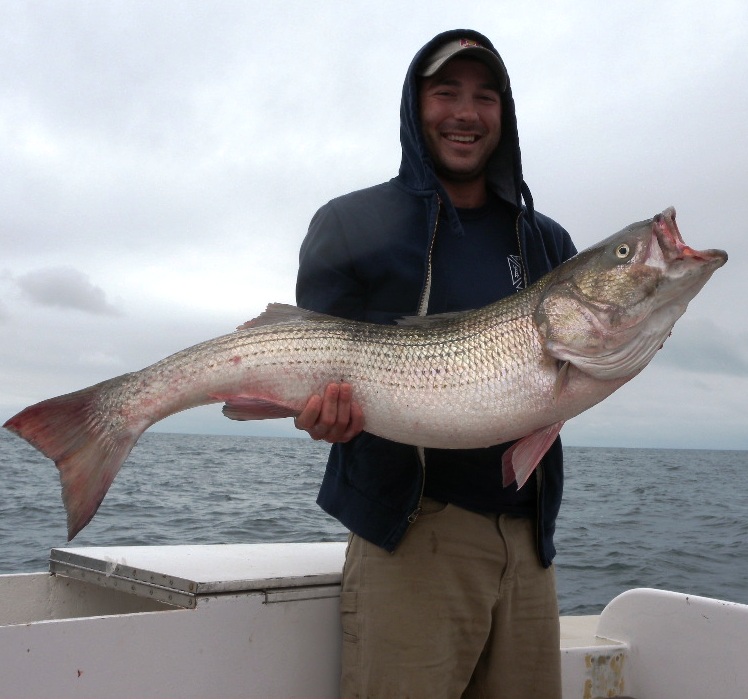
Bass off Block Island: Warwick Fire Fighter Mike Schmidt with a 30 pound striper that took a Yellow and White Poly-jig while on Priority Too Charters.
The Rhode Island Saltwater Anglers Association has a great line-up of topics for their Monday, September 27th seminar.
Now is your chance to learn how to catch striped bass consistently just as great charter captains of Rhode Island have been doing for years off Block Island. Curt Caserta, who will present what he has learned from character captains, said, “I have taken little pieces of techniques and information and tried to adapt them to what works best for me…” Topics covered include techniques such as the correct direction to pitch your bait, how to set-up a drift, properly position your boat, the importance of electronics, the benefits of finding your own fish while staying away from others as well as the gear and tackle that works best.
The session will also include three mini seminars featuring Steve McKenna, renowned Rhode Island surf fisherman from Cranston, RI, and an associate at Quaker Lane Outfitters in North Kingstown, RI. Steve will talk about the fundamentals of fishing. Next, Mike Fotiades will talk about something I have always wanted to learn…how to properly throw a cast net. With fresh live bait fairly abundant in the Bay and Ocean (such as menhaden) this is something that could enhance your fishing experience and catch all at the same time. The third mini-seminar will be handled by Tom Wood and the topic is trailer safety. We all have experienced or witness trailer nightmares at the boat ramp or on the road. This session is sure to help keep you safe and avoid accidents.
The seminars begin at 7:00 p.m. and are held at the West Valley Inn in West Warwick. The public is welcome, although a $10 donation is requested for the RISAA Marine Fisheries Scholarship Fund. Dinner, sponsored by the West Valley Inn, is available between 5:30 and 6:30 p.m.
For more information about these seminars check out the RISAA web site at www.RISAA.org or call 401-826-2121.
Anglers oppose ban on lead sinkers and lures
On August 23, 2010, the Environmental Protection Agency (EPA) was petitioned by the Center for Biological Diversity and four other organizations to ban all lead in fishing tackle under the Toxic Substances Control Act. This includes sinkers, jigs, weighted fly line, and components that contain lead such as brass and ballast in a wide variety of lures, including spinners, stick baits and more.
The petition was presented with the aim of reducing bird deaths caused by the ingestion of lead sinkers and jig heads; however, a study conducted by the U.S. Fish and Wildlife Service found that less than one percent of all waterfowl and other birds such as eagles are killed by lead sinker ingestion.
The American Sportfishing Association (of which RI Saltwater Anglers Association is a member), has provided a special web page at www.keepamericafishing.org (under Top News items dated 8/31/10) explaining the reasons why anglers should oppose the ban and how to help by sending an email to your state's legislators in Washington.
Newport Boat Show
Exhibitors at the Newport International Boat Show related attendance was good this weekend and I sensed more sales activity than they had last year. I looked at three center console fishing boats for in-shore and near coastal fishing (something you could take to Block Island).
The first manufacturer was Parker represented by Don’s Marine of Tiverton, RI. Tom Grimes of Don’s related that Parker’s claim to fame was “strength, simplicity and seaworthiness”. He jumped up and down on the gunnels to demonstrate the vessels stability (the vessel has a roomy 9’6” beam). They were showing a 25’ center console as a show special priced at about $50,000 and their new 2100 Special Edition 21’ center console (again built well for fishing).
I also spoke with Jim Shriner of Mill Creek Marine (the former Johnston’s Boat Yard located in Wickford, RI). Jim said, “We are focusing on selling Eastern boats, a value line with roots in commercial boat building…the nice thing is that they are built locally in Milton, New Hampshire and you can order a boat the way you want it.” Jim related that the new 24’ center console (offered between $50,000 and $60,000 depending how it is ordered) is ideal for fishing and was enhanced last year with an 8’6” beam.
The last fishing vessel I looked at is one of the high performance fishing center consoles on the market… the Pursuit C280. This boat was built with the offshore fisherman in mind. It has a 24 degree dead rise to cut through heavy seas and features a large 52 gallon live bait well. Pursuit is known for performance, fit and finish and they are represented locally by Striper Marine of Barrington, Rhode Island. Striper Marine’s show special price on the C280 was $139,900 said Gregg Wheaterby, sales representative from Pursuit.
Where’s the bite
Striped bass fishing is improving on the Bay. Fish are being taken north of the bridges as well as along the southern coastal shoreline of RI. Ken Ferrara of Ray’s Bait & Tackle, Warwick, reports customers are catching bass at Warwick Light. A good striped bass bite mixed with blues off point Judith Light this week. Prior to the high seas on Block Island and Rhode Island Sound striped bass fishing off Block Island was great. Anglers continue to take fish in the 30 lb. range using eels 2 ½ miles off the southwest side. Captain Sheriff Charters reported taking fish up to 40 lbs. using ells last Wednesday one mile off the SW corner of Block Island. This weekend bass between 15 and 32 lbs. were taken on the Southwest side of Block Island using Poly-Jig Parachutes said Captain Rick Bellavance of Priority Too Charters.
False Albacore fishing remains very good off Point Judith with a number of fish being taken off the center and east walls this past week. Green Deadly Dicks seemed to be their bait of choice this week. Fish also off and between Newport and Beavertail in Jamestown.
Bluefish are now large and can be found throughout Narragansett Bay and off shore. RISAA blog member Brian Woodard reports taking eight to ten pound bluefish off Prudence Island this Saturday using chunks of porgy in forty feet of what. Brain said “Every ten minutes a school of monster blues would swim by and attack our lines…” Last week I caught blue fish as large as 30 “ while fishing with tube and worm on the channel pad off Poppasquash Point, Bristol. Smaller bluefish also caught close to Prudence Island near Bear Point with swimming lures.
Tautog fishing is encouraging and good on the Bay and off coastal shores between Newport and Point Judith. Good number of keeper fish reported being taken off Beavertail this Sunday in high seas as well as at Whale Rock, Narragansett,; Plum Point Light House next to the Jamestown Bridge; around General rock off Wickford; and around the jetty at Coddington Cove in Middletown.
Fishing after storms can be good

Other contributing factors to good fishing after storms are geography and storm patterns. For example, with storms coming out on the north and northeast bait, crabs, etc. get pushed to the opposite shoreline or get hung up on ridges. Fish the opposite shoreline after a storm and you are more likely to catch fish because the bait is there said Steve McKenna of Cranston and an associate at Quaker Lane Outfitters in North Kingstown. Steve continued, “I like to fish the fist clearing wind after a big storm once the sea settles down a bit… I caught my last three 40 lb. striped bass after storms.”
I asked Captain Rich Hittinger for his thoughts about fishing conditions after a storm. Captain Hittinger said, “The fluke (were) back at North Rip (Block Island) since last Tuesday. But, things will change after the storm … At this time of year storms have sometimes sent the fluke packing to deeper water with no significant bite until the following spring. It also can chase the giant tuna out of here for the season, but we can only wait and see what happens. In any case the scup, sea bass, and stripers will still be here after the storm, but it may take a few days before they settle back into a feed.”
I plan to put these “fishing after a storm” strategies to the test and will keep you posted.
How gubernatorial candidates stand on recreational fishing issues
Recently the Rhode Island Saltwater Anglers Association (RISAA) asked all eight gubernatorial candidates their thoughts on five issues important to recreational anglers. All candidates except Ronald Algieri (Independent) replied. The five issues included questions on: artificial reefs; the Weaver Cove LNG Project; public access to the shoreline ; the Jamestown Bridge fishing pier; and support of the existing no sales tax on boats law.
I carefully read and re-read candidate responses and have to report that candidates responded but many did not commit or they committed to support an issue with conditions. Details on their responses can be found on the RISAAA website in their September newsletter at www.risaa.org . Here is a summary as to how I interpreted candidate response… many support RISAA and fishermen but four candidates stood out with their responses supporting most angler issues unconditionally. Kenneth Block (Moderate), Frank Caprio (Democrat), Lincoln Chafee (Independent), and Victor Moffitt (Republican) were supportive to recreational fishermen’s concerns. I urge you to read candidate responses on the RISAA web site and decide for yourself.
Where’s the bite
Off-shore fishing was good prior to the storm last week. Angler Mark Pietros reports on the RISAA blog that he had all the cod fishing action he could handle last week along with haddock, Pollock and “the biggest hake” he ever caught. He fished in 220 feet of water at Stellwagon which is in the eastern edge of Massachusetts Bay off Race Point between Cape Cod and Cape Ann. Captain Rick Bellavance of Priority Too Charters reported catching a 300 lb. blue shark at the Mud Hole and said that two boats hooked-up with bluefin tuna. The vessel Tuna Tangler landed their fish and Duck Soup (who caught a nice fish a couple of weeks ago) lost their fish after a long battle as it got dark.
Bluefish. Captain Rick Bellavance reported plenty of bluefish at the north end of Block Island as well as some huge scup and black sea bass around Clayhead, Block Island.
Black sea bass fishing off Newport was good early Monday (see fishing after the storms article above) for those who fished the outgoing tide, once the tide switched to an incoming tide the bite slowed right down. Keeper fish that I caught Monday (and as reported by Paul Tower on the RISAA blog) were coughing ups small 3 inch lobsters, they must of really had the feed bag on.
Bay fishing was very slow this week as water heated up again to over 75 degrees in some areas. Let’s hope the storm and following weather cools the water and the fish come back.
Fresh water fishing for bass is good. Craig Castro of Erickson’s Bait & Tackle in Warwick reports customers are doing well fishing for bass in RI ponds and lakes. “This is tournament season and several customers came is this week getting ready for tournaments in MA, RI and CT”, said Castro.
Fish poaching penalties… and a great shark story
DEM said they had information that Reeves was illegally taking over limits of striped bass in Rhode Island and selling them in Massachusetts and that he had the extra fish in a hidden compartment on his boat. The officers stopped him while driving on Route 1 in Rhode Island after fishing. Officers found a secret compartment that opened hydraulically with eleven (11) illegal fish (in addition to the two legal fish he had in his possession). The state seized Reeves’ boat and eqipment. His arraignment is scheduled for September 1.
RIDEM officers are familiar with Reeves. He was arrested, charged and pleaded NOLO in July of 2003 for the same offense. He was fined $450.00.
Poaching by anyone, recreational fishermen or commercial fishermen can have a negative impact on a fishery and fishing community. I asked a couple of anglers, charter captains and fishing authorities their thoughts on this poaching incident and if in general penalties should stay the same or be enhanced. Here’s what they had to say.
Captain George Cioe, Narragansett, RI…“I believe that when a vessel is designed to conceal criminal activity that it is a sure indication of habitual offense. Therefore the vessel should be seized and the funds given to DEM for future enforcement efforts or equipment.”
Steve Medeiros, president, Rhode Island Salt Water Anglers Association…“We hope that this time the court will agree to seize his boat and equipment. A day's illegal catch can be valued at hundreds of dollars, and many poachers do this EVERY DAY! It is time for the fines for such violations be increased. It is time for the General Assembly to change the fisheries laws and allow for the increase of such fines.”
Captain Rick Bellavance, Priority Too Charters, president of the RI Party & Charter Boat Association… “I favor a modest fine for first time offenders.( I would suggest a temporary suspension of their commercial fishing license and a fine.) Repeat offenders should be subject to an increasing fine structure, to include forfeiture of their State Commercial Fishing License... Recreational fishing fine structure should also be reviewed with the possibility of loss of Salt Water License. According to MRFSS, Non-Compliance among many species is in double digit percentage of recorded intercepts. Due to the number of private anglers, this equates to a much larger number of illegal fish than are illegally harvested commercially.”
Grand opening for new Mt. Hope boat launch.
DEM held opening ceremonies for the Mount Hope Boat Launch Improvement Project in Bristol on Monday, August 16. The old boat launch located behind the RI Veterans’ Home has been replaced with a new, 60-foot wide concrete ramp and two floating courtesy docks. The new Mount Hope facility is accessible to boaters with disabilities.
DEM said a dredged channel from the new boat ramp location, which is north of the old Mount Hope boat ramp, into deep water will accommodate larger boats brought in by trailer to the new facility. This new ramp is the only public boat launching ramp of its size in the Rhode Island portion of Mount Hope Bay.
Menhaden advisory panel meeting
A meeting of the Rhode Island Marine Fisheries Council Menhaden Advisory Panel has bee scheduled for Tuesday, September 7, 2010 at 6:00 P.M. at the URI Bay Campus, Coastal Institute, Hazard Room which off South Ferry Road in Narragansett, RI. Agenda items include the most up to date stock status and a review of current regulations and proposals for any changes to current regulations. Anglers interested in expressing their thoughts about menhaden regulations are urged to attend the meeting.
Clam regulations change back to the way they were
DEM filed new emergency regulations with the Secretary of State while rescinding emergency regulations that were filed the week before relating to the harvest of soft-shell clams from the newly opened shell fishing area near Conimicut Point. Effective immediately, time restrictions on the harvest of soft-shell clams in the shell fishing area near Conimicut Point have been eliminated. The area will be open from sunrise to sunset, as are other shellfish harvesting areas. The emergency regulations filed on August 5 limited the harvesting hours from sunrise to noon. The regulatory change was made after it became apparent that the time restriction had an unfair impact on clam diggers as they claim they usually can only harvest product during periods of low tide.
Where’s the bite
Striped bass fishing off Block Island remains good with blue fish mixed in. Anglers taking fish jigging (Diamond Jigs), with eels and tube and worm. Reports for several anglers and charter captains related that this week the best fishing has been on the south and southwest sides of the Island with the north rip still holding fish too. Fishing off Newport has produced fish too. For the second week in a room I caught a keeper bass under the Newport Bridge while fluking close to the swirling water around bridge piers.
Fluke (summer flounder) fishing has slowed down this past week due to the odd wind direction and juxtaposing tide, high seas. Fish still holding near coastal shores with no major reports of catches in the Bay. Ken Ferrara of Ray’s Bait & Tackle, Warwick, said reports of fluke off Newport (Brenton Reef, the Inn at Castle Hill), off Jamestown (Beavertail and in front of Mackerel and Hull Coves). Tom of Erickson’s Bait &Tackle said the sand bar off the south side of Gould Island had been good too. Block Island fluke fishing is expected to improve this week with favorable winds and tides.
A great shark story
Off Shore fishing reports have not included bluefin tuna. Rick Bellavance of Priority Too Charters said, “…I would say tuna is slow and sharking is good. I did see some encouraging signs near Coxes, so the action will soon begin.” Captain Bellavance continued, Saturday “We hooked a Blue Shark which had a NMFS tag in him. After retagging the shark, I removed the old tag and let him go in good shape. … A couple hours go by with nothing, then the short line goes off. .. a 13 foot Thresher Shark comes flying out of the water.. The guys did a great job listening and fought the fish perfectly… the fish jumped a couple more times and after an hour, I stuck it with a harpoon, sunk a flying gaff into it and had a tail rope in place. Done. We packed it in and headed for Snug Harbor, where the fish weighed in at 288 pounds.” Captain Bellavance said, “Thresher Sharks are delicious food (like swordfish) and my customers wanted to eat it … If the shark was not good to eat, we would have tagged it for research and let it go.”